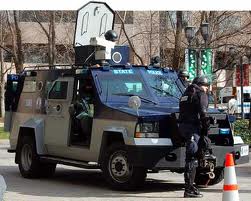
At the core of 'the state' is the coercive threat and use of violent
force. If 'the state' did not reserve for itself the use of force it
would fail. In general people may appear to willingly comply with the
requirements of the state but that is either because:
* they would act in that way regardless, (they would generally not want to transgress against other people's property), or
* they would act in a different way to the edicts of 'the state' but do not because of the prospective repercussions, or
* they believe it is moral to comply with the edicts of 'the state'.
'The state' is central to, sets the tone of, modern human society in great part. Because people individually agree that employing the use of force is only moral in defence of self and property and agree that groups of people have no more right to employ force than they do individually, there is an unanswered dichotomy, a dissonance, between the circumstances when an individual can morally use force and when 'the state' makes use of it. There is no moral justification for 'the state' to use force outside of those same perimeters of an individual's moral legitimacy.
When 'the state' employs morally illegitimate violent force it attempts to set itself apart from human morality and instead endows itself with a false morality to break this code. Without violent force at its disposal 'the state' ends. 'The state' is nothing without the use of violent force. 'The state' is nothing but violent force. 'The state' is violence.
* they would act in that way regardless, (they would generally not want to transgress against other people's property), or
* they would act in a different way to the edicts of 'the state' but do not because of the prospective repercussions, or
* they believe it is moral to comply with the edicts of 'the state'.
'The state' is central to, sets the tone of, modern human society in great part. Because people individually agree that employing the use of force is only moral in defence of self and property and agree that groups of people have no more right to employ force than they do individually, there is an unanswered dichotomy, a dissonance, between the circumstances when an individual can morally use force and when 'the state' makes use of it. There is no moral justification for 'the state' to use force outside of those same perimeters of an individual's moral legitimacy.
When 'the state' employs morally illegitimate violent force it attempts to set itself apart from human morality and instead endows itself with a false morality to break this code. Without violent force at its disposal 'the state' ends. 'The state' is nothing without the use of violent force. 'The state' is nothing but violent force. 'The state' is violence.

This violence, which is 'the state', is the cause of enormous harm that runs through human society as a virus. 'The state' breaks the moral code that is the foundation upon which a harmonious human society should be founded. The overall effect of this violence at the core of 'the state' is that the infection spreads through human society and especially manifests in weak points within the social order.
So how would a stateless society deal with crime? In a fully functional stateless human society crime would be vastly reduced as a result of having taken the use of faux legitimated violence out of the core of society. There would still be crime one can suppose, human nature remains and part of that may be for some to still act immorally, against others and their property, if they can get away with it. So assuming there would remain some crime in a stateless society it would need to be dealt with or the immoral people would simply be unconstrained and encouraged.
The lesson to be understood when accepting the utility of a stateless human society is that: answers to every supposed problem are possible to find and then develop. All the people working toward finding resolutions to the needs of society will develop a plethora of solutions and the best of those will rapidly be widely employed. Further, attempting to predict what these solutions will be is as ridiculous, and likely as inaccurate, as it would have been attempting to describe how society and the economy would appear and function after the abolition of slavery. Slavery was not ceased because a 'slavery-free' future was planed and understood in detail but because the immorality of slavery demanded it was made to end. So it must be demanded that 'the violent state' is made to end too.

I do have many ideas of cause as to how free-market policing and justice would take place in a system offering a level of service and accessibility clearly unobtainable when these functions of human society are usurped and monopolised by 'the state'. I too have ideas for what would replace 'the state' operated penal system. The focus of that would greatly depend on what the free-market demanded and what the free-market judicial system could legitimately find legally sound and therefore moral.
I suppose when people cannot be made, by the threat of violent force, to pay to incarcerate offenders there will be a very different criteria emerge as to what is realistically desirable, such as cost-effective achievable goals for reform, deeper psychoanalytical understanding, life-retraining and so on. People who had to be removed from society because of the danger they presented would need to also be accommodated within a system, but clearly; being faced with an entire population entitled to carry whatsoever means of protection they felt prudent the population of hardened criminals would soon reduce to manageable numbers too.



Just one of these fat worms is hinted at with a story in The Sunday Times: ‘Apps spy on phone messages’ (which you cannot access without a subscription).
But the gist of it below is at this link : http://www.theweek.co.uk/daily-briefing/45566/ten-things-you-need-know-today-sunday-26-feb-2012
3. PHONE APPS SPY ON MESSAGES
Companies, including Facebook, are using smartphone apps to spy on users’ phone messages and gather information about their lives. A Sunday Times investigation also found that some apps can access users’ internet history which is transmitted to third party advertisers, while other apps can remotely control a phone’s camera.
My reading of the publication of this item is to set the ground for if and when it comes out that Screws Indigestible has been doing a lot more than just hacking mobile answer-phones or even computer e-mail. It is to say ‘look folks; everybody’s doing this stuff, its not really so bad and scary. It's the new normal’.
See here an idea of what else is possible when actually 'hacking' mobiles: http://eubrainwashing.blogspot.com/2011/07/more-to-phone-hacking-than-accessing.html
But the effect of such revelation still has the potential to be devastating for NI and the Mudoiks.
The can chock full of juicy worms could well go deeper still. That would be who helped, who allowed powers reserved for the highest levels of police investigation and state security to be usurped for ‘third-party’ surveillance. Surveillance not only of a meaningless celebrity’s toilet habits but such that could compromise national security and those in positions of real power and authority. And yet deeper; is it only the news rooms of NI that benefited from such knowledge and leverage that may have resulted or could this spying network have a darker beneficiary than just pennies on a news-stand.
Trust that such would not occur, just because it should not occur, is misplaced.